Gaffer FC teaches the core of football tactics in seven modules: positions, formations, concepts, cascade (cause and effect), set pieces, a minigame with a quiz, and a glossary. You learn by clicking players on an interactive pitch, stepping through animated sequences and making decisions against a CPU opponent, rather than watching lessons. This guide walks through each module, what you actually do in it, and where it stops.
Key Takeaways
- Gaffer FC is a browser-based course with seven learning modules plus a free-play tactics Board, on desktop and mobile browsers.
- The content covers 8 position profiles, 4 formations (4-3-3, 4-2-3-1, 4-4-2, 3-5-2), 12 tactical concepts, 4 cascade scenarios, 6 set-piece routines, 27 glossary terms and 18 quiz questions.
- A suggested trail runs Positions, Formations, Concepts, Cascade, Set Pieces, Quiz, then Minigame, so each module builds on the last.
- You earn XP from lessons, the quiz and the minigame, moving through 7 levels from On the bench to The Gaffer and unlocking 7 achievements.
- It is a course for fans who want to read matches, not a coaching qualification, and it has no video lessons.
What Does Gaffer FC Teach?
Gaffer FC teaches you to read what teams are doing on the pitch: who stands where and why, what a formation solves and gives up, and how one movement forces a reaction from the other side. It is aimed at fans who watch a lot of football and want to understand it, not at coaches running sessions.
In the app, the content sits in tabs: Home, Positions, Formations, Concepts, Cascade, Set Pieces, Glossary, Quiz, Minigame and Board. Home holds your progress and the suggested trail. The Board is a sandbox rather than a lesson. The other eight tabs make up what we call the seven modules, with the quiz grouped alongside the minigame because both test what you have learned.
The order matters. We have argued before that learning tactics by doing beats collecting clips, but doing only works if the foundations come first. That is why the trail starts with individual roles and only reaches the minigame at the end.
How Do the Positions and Formations Modules Work?
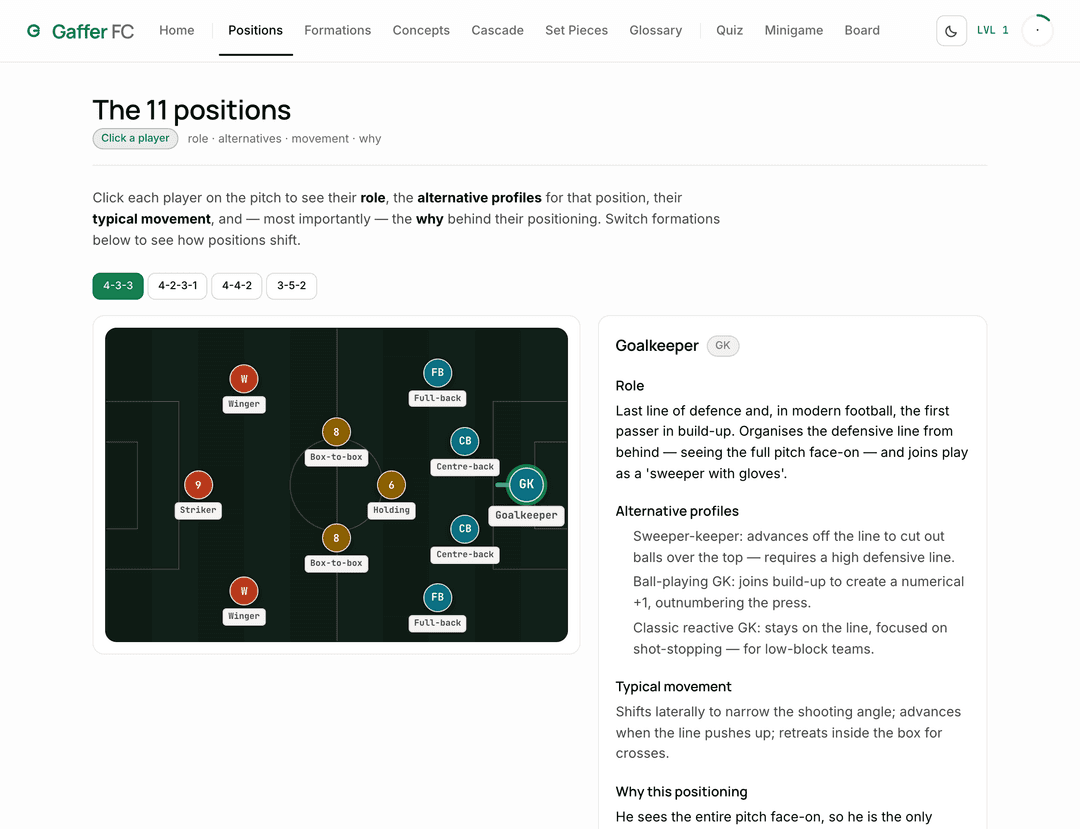
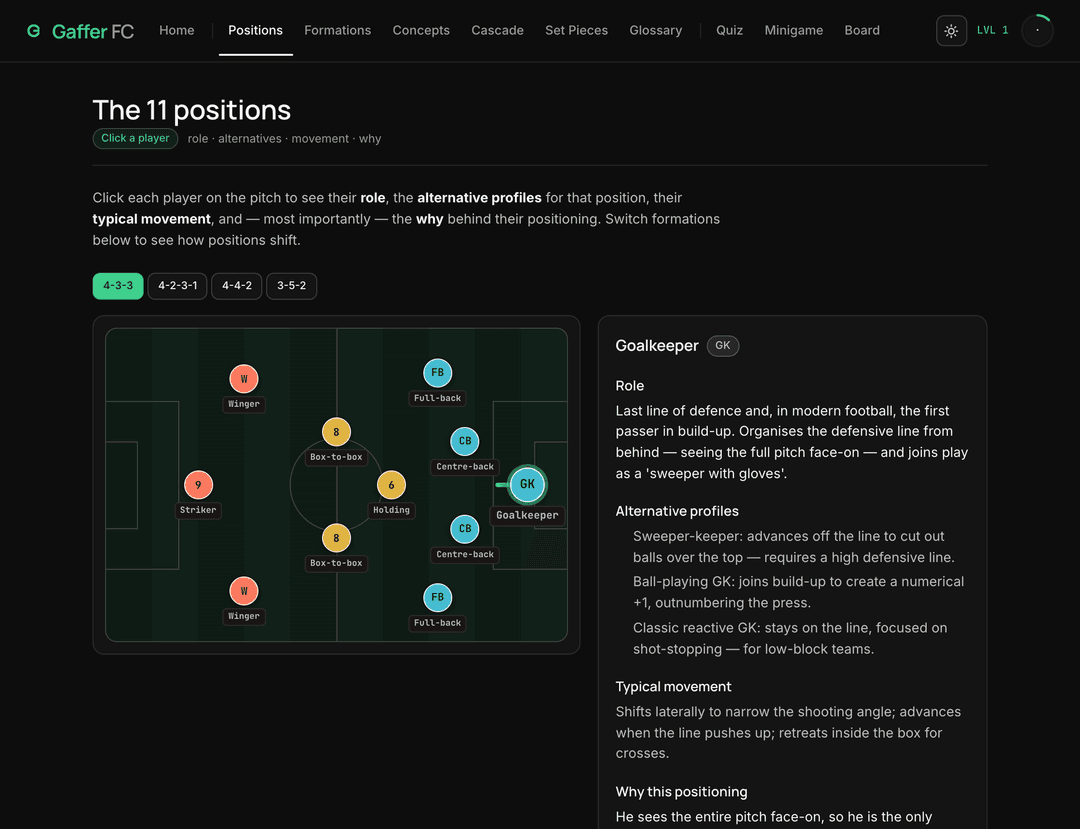
The Positions module is an interactive pitch: you click any player and a panel explains that role. Each profile covers the role itself, alternative profiles of the same position, typical movement, and a section on why the player stands where they do. There are 8 profiles: goalkeeper, centre-back, full-back, defensive midfielder, central midfielder, attacking midfielder, winger and striker.
You can switch the pitch between four formations, 4-3-3, 4-2-3-1, 4-4-2 and 3-5-2, and watch the same role sit differently in each. For example, a full-back in a 4-4-2 usually has a winger directly ahead of him, while in a 3-5-2 that flank belongs to a wing-back and the full-back role effectively disappears. Seeing that switch on one pitch is quicker than reading about it. If you want the free version of this material first, our full-back reference page covers the basics.
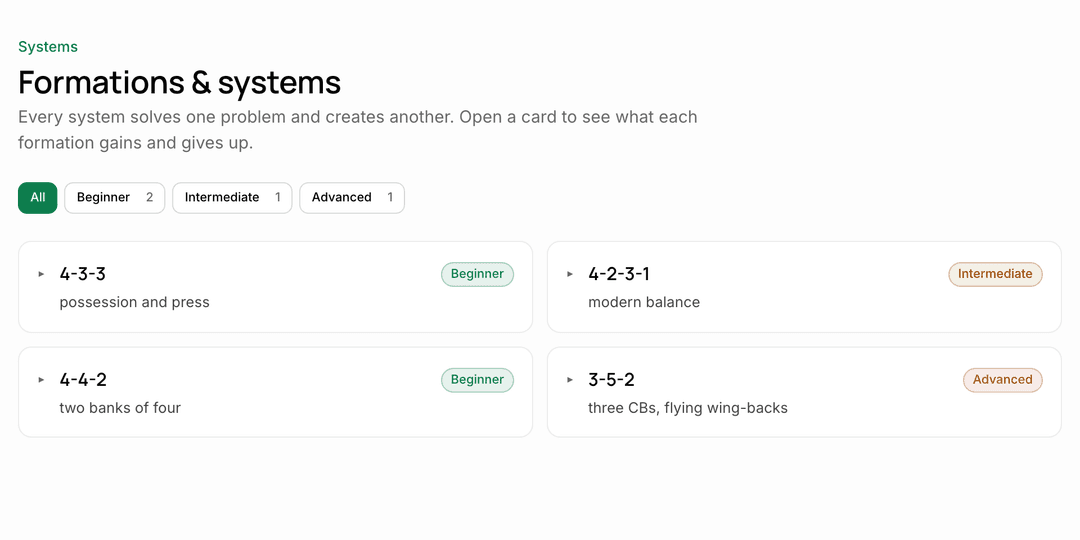
The Formations module then looks at the same four systems as whole structures. Each card explains what the formation solves, what it gives up, and when a manager might choose it, and you can filter the cards by level. A 4-3-3, for instance, gives you three midfielders and natural width from the wingers, but it can leave the lone holding midfielder exposed if the 8s push on, which is the trade-off our 4-3-3 explainer covers in more depth.
What Are the 12 Concepts in Gaffer FC?
The Concepts module covers the 12 ideas that explain most of what you see in a modern match. Each one is tagged beginner, intermediate or advanced, so you can start with the basics and leave the harder material for later.
- High press and the defensive block (low, mid and high): where a team chooses to defend.
- Compactness and strong side / weak side: how a team shrinks space around the ball and what that leaves open.
- Transition and the 5-second window: what happens in the moments after the ball changes hands.
- Numerical superiority, width and depth, and the half-space: how attacks create and use space.
- Overload to isolate and the third-man run: two patterns for getting a player free.
- Marking (zonal, man and hybrid) and the offside trap: how defences organise against runners.
Take strong side and weak side as an example. When a team shifts across to crowd the ball, the far side of the pitch empties. The concept card explains why that happens and why a quick switch of play is often the answer. Once you have that picture, a 50-yard diagonal pass stops looking like a random hit and starts looking like a plan. The half-space and overloads explainers on the blog go deeper on two of these.
How Do Cascade and Set Pieces Show Cause and Effect?
The Cascade module shows one tactical trigger and the chain reaction it sets off across both teams, step by step on an animated pitch. You move through it with play, previous and next, so you can stop at the step that confuses you and replay it.
There are four scenarios: a full-back overlap, pressing the opponent's build-up, losing the ball, and a number 10 receiving between the lines. In the pressing scenario, the sequence starts with your striker's curved run, which pushes the centre-back towards his weaker side. Your winger then presses the full-back, the full-back has no short option, and your holding midfielder steps in to intercept the pass into their 6. The final step shows the risk if the press is beaten. That last step is the useful one: it reminds you that every tactical choice has a cost.
The Set Pieces module works the same way, with synced step-by-step narration over an animated routine. There are six: a corner with a near-post screen, a short corner creating a 2v1, a lateral free kick with a rehearsed decoy, a direct free kick over the wall, the penalty as a reading duel between taker and keeper, and defending a corner with mixed marking.
A formation tells you where players start. The cascade shows you what happens when one of them moves.
How Do the Quiz, Minigame and Glossary Check What You Learned?
The quiz and minigame are where you stop reading and start answering. The quiz has 18 questions across topics such as pressing, transitions, positions, overloads, shape, half-spaces, set pieces and build-up, with instant feedback on each answer.
The minigame is a turn-based match against the CPU. Each match runs for 6 phases, drawn from a pool of 12 scenarios. In each phase you read what the CPU is doing and pick a response, such as a high press with a triggered run, a mid-block, or a switch to the weak side. Each decision is rated Excellent, Neutral or Poor and shifts possession, energy and momentum. We explain it fully in how the Gaffer FC tactical minigame works.
There is a reason the course ends on questions rather than more explanation. In a well-known 2006 study, Roediger and Karpicke found that students who took recall tests on a passage remembered 56% of it a week later, against 42% for students who simply restudied it. A larger review of learning techniques by Dunlosky and colleagues rated practice testing as one of the two most effective strategies they examined. A tactics quiz is not a university exam, but the principle that retrieving an idea helps you keep it applies here too.
The Glossary is the reference shelf: 27 terms, from the basics to the jargon that turns up in commentary. A shorter public version lives at /glossary.
How Do Levels, XP and Achievements Work?
You earn XP for lessons you view, your quiz score, minigame wins and winning streaks, and for achievements. XP moves you through 7 levels: On the bench, Squad player, Starter, Playmaker, Captain, Assistant coach and, at the top, The Gaffer.
The 7 achievements are tied to specific milestones:
- Tactical Observer: view all the position profiles.
- Pattern Recognition: view all 12 concepts.
- First Blood: win your first minigame scenario.
- Winning Run: win 3 in a row.
- Tactical IQ: score 80% or more on the quiz.
- Elite Mind: beat the Elite difficulty.
- Full Scout: view all positions and concepts.
Levels are a progress marker, not a measure of expertise. Reaching The Gaffer means you have worked through the course. It does not mean you could coach a team. One practical point: progress is saved in the browser on the device you use and does not sync between devices, so stick to one browser if you care about your level.
Watch forAfter finishing the Concepts module, watch the first 15 minutes of your next match and track only one thing: which side is the strong side, and how long it takes the team without the ball to shift when play is switched.
What Does the Curriculum Not Cover?
Gaffer FC is deliberately narrow, and it is better to know the limits before you start. There are no video lessons and no real match footage. It is not a coaching licence and does not teach session planning, fitness or player management. There is no community or forum, and no live coaching.
The content is also a model of football, not football itself. The minigame simplifies a match into six decision points, and four formations do not cover every system you will see. If you want analysis of specific teams and managers, the free blog does that, for example in our breakdowns of Pep Guardiola's tactics and Mikel Arteta's tactics. Gaffer FC gives you the vocabulary and the patterns. Applying them to real matches is up to you.
If that sounds like what you need, the module overview on the homepage shows each tab before you buy.
Frequently Asked Questions
How many modules does Gaffer FC have?
Gaffer FC has seven learning modules: positions, formations, concepts, cascade, set pieces, the minigame with its quiz, and the glossary. In the app these sit in tabs alongside Home, which tracks your progress, and Board, a sandbox where you drag players and the ball around a pitch. The suggested trail on Home takes you through them in order, from Positions to the Minigame.
Do I need to know tactics before starting Gaffer FC?
No. The Positions module starts with what each player does, and the concepts are tagged beginner, intermediate or advanced so you can begin with the basics. A short onboarding explains the app on your first visit. If you already know the fundamentals, you can skip ahead, but the quiz and minigame will still show quickly whether there are gaps.
Does Gaffer FC include video lessons?
No. Gaffer FC has no video lessons or match footage. You learn by clicking players on an interactive pitch, stepping through animated cascades and set-piece routines with narration, answering quiz questions and making decisions in the minigame. If you prefer learning from video, free YouTube channels are a good complement, and we compare the two approaches in a separate guide.
Which formations does Gaffer FC cover?
Gaffer FC covers four formations: 4-3-3, 4-2-3-1, 4-4-2 and 3-5-2. In the Positions module you can switch the pitch between all four to see how each role changes. In the Formations module, each one gets a card explaining what it solves, what it gives up and when a team might use it, and you can filter them by skill level.