The Gaffer FC minigame is a turn-based tactical match against the CPU. Each match has 6 phases drawn from a pool of 12 scenarios. In each phase you read the CPU's move, choose your team's response, and see that decision rated Excellent, Neutral or Poor as it shifts possession, energy and momentum. It teaches you to think like the person making the call, not the person watching it.
Key Takeaways
- A minigame match is 6 phases, each a tactical situation drawn at random from a pool of 12 scenarios, such as an opponent's build-out or a full-back overlap.
- In every phase you choose one response from several options, for example a high press with a triggered run, a mid-block, a low block or a man-to-man press.
- Each decision is rated Excellent, Neutral or Poor and changes three meters: possession, energy and momentum, which open or close scoring chances.
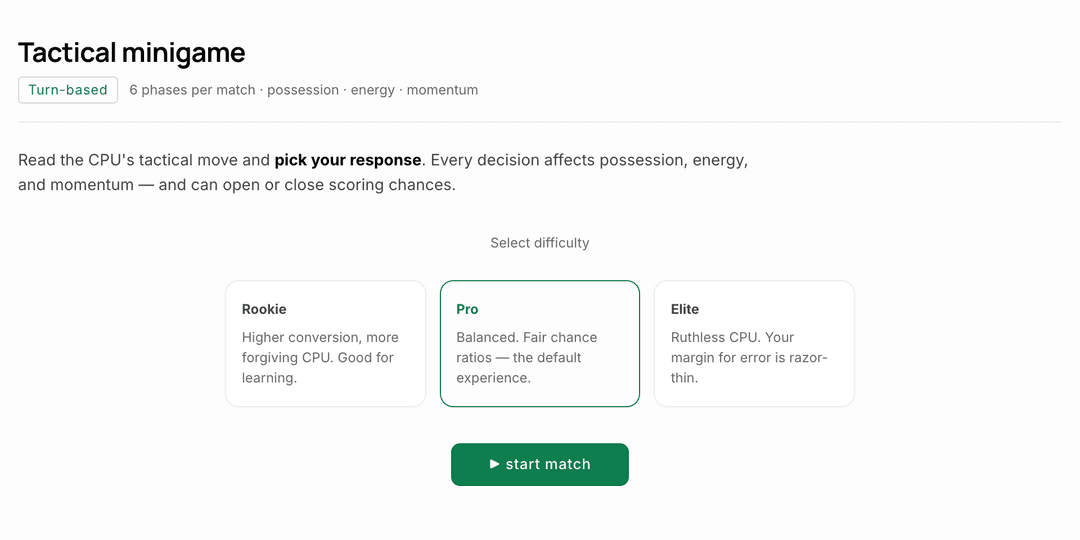
- There are three difficulties: Rookie (more forgiving), Pro (balanced) and Elite (ruthless).
- The end-of-match summary shows a grade, a log of every decision and the match trends.
How Does a Gaffer FC Minigame Match Work?
A match is a short series of tactical decisions, not a real-time football simulation. You play 6 phases, and each phase is one situation taken from a pool of 12 scenarios, so two matches rarely look the same. The scenarios cover both sides of the ball: some ask how you defend the CPU's build-up, others how you turn your own possession into a chance.
Each phase has the same rhythm. First the CPU's move is described: what shape it is in and what it is trying to do. Then you get the question, for example how your team responds to their build-up, and a set of options. You pick one, and the match moves on with the consequences.
The minigame sits at the end of the suggested trail on purpose. It assumes you have met the ideas in the Positions, Concepts and Cascade modules, because the options use that language. If "mid-block" or "weak side" mean nothing yet, start with the curriculum guide or our free high press vs low block explainer.
What Decisions Do You Make in Each Phase?
You make the kind of decision a manager or a captain makes in the moment: where to defend, how hard to press, and where to attack. The options in a phase are deliberately plausible. None of them is a joke answer, which is what makes the choice useful.
Out of possession, the decisions are about pressure and height: a high press with a triggered run, a mid-block that holds shape, a low block with everyone behind the ball, or a man-to-man press across the pitch. In possession, they are about where to go next: an overlap, a switch to the weak side, or playing it back to rebuild. Other scenarios include neutralising an opposition number 10 between the lines.
The right answer depends on the situation described, not on a general rule. A switch to the weak side is a strong move when the defence has crowded the ball side. Playing it back and rebuilding is sensible when you are outnumbered, and wasteful when you already have a free player. Learning to tell those situations apart is the point.
Walkthrough: Defending the CPU's Build-Out
Here is one phase in detail, so you can see how the reasoning works. The CPU is building out from the back. Both centre-backs have split wide and their holding midfielder has dropped between them, creating a 3v2 against your two front players. The question is how your team responds.
You have four options:
- High press with a triggered press run. You push the block up and your striker curves his run to close off one side.
- Mid-block, hold shape and wait. You do not press. You keep the lines compact and invite them forward.
- Low block, everyone behind the ball. You drop into your own half completely.
- Man-to-man press across the whole pitch. Every player follows an opponent everywhere.
Which option is rated Excellent, and why?
The high press with a triggered run is the Excellent answer. The curved run is the key detail: by running at an angle, the striker blocks the pass back into the middle and funnels the centre-back towards the touchline, where the sideline acts as an extra defender. Your winger can then jump onto the full-back. The trigger matters as much as the press. Pressing on a cue, rather than all the time, is what makes it work, as our guide to pressing triggers explains.
Why is the mid-block only Neutral?
The mid-block is safe but passive. You give up the build-up phase and some possession, but you keep short distances between your lines, so their number 10 has no room to receive. Nothing goes badly wrong. You simply miss the chance to win the ball high up the pitch.
Why are the low block and the man-to-man press Poor?
The two extremes fail for opposite reasons. The low block is too deep, too early: you hand them the whole pitch and get pinned in your own box. The man-to-man press is too aggressive without a trigger: one good pass from a centre-back breaks it and leaves your team stretched for a counter. It also burns a lot of energy, which you will feel in later phases.
That phase contains a whole lesson on pressing in a minute of play. You do not just learn that "a high press is good". You learn that a press needs a trigger, that the angle of the first run matters, and that the cautious option and the reckless option both have a cost.
Every option in a phase is something a real team might try. The skill is knowing which one fits the situation in front of you.
What Do Possession, Energy and Momentum Mean?
Possession, energy and momentum are the three meters that carry the consequences of your decisions from one phase to the next. Possession reflects how much of the ball you are getting. Energy drains as you go, faster with the more demanding options. Momentum reflects which team is on top.
Together they open or close scoring chances, for you and for the CPU. That is what turns the minigame from a quiz into a match. A man-to-man press might win the ball once, but if it leaves your energy low, later phases become harder. A string of good reads builds momentum and makes chances more likely. Football works the same way: teams that press hard for an hour often pay for it late on.
Rookie, Pro or Elite: Which Difficulty Should You Pick?
Start on Rookie, move to Pro once you are winning, and save Elite for when you want a test. Rookie is more forgiving, so your good decisions turn into goals more often and your mistakes are punished less. Pro is balanced and is the standard experience. Elite is ruthless and leaves very little margin for error.
The decisions themselves do not change between difficulties. The same read is right on Rookie and on Elite. What changes is how much the result punishes a bad choice and rewards a good one. Beating Elite unlocks the Elite Mind achievement, and minigame wins and streaks also earn XP towards your level.
What does the end-of-match log show?
When the 6 phases are over, you get a summary with a grade, a decision log and the match trends. The log lists every phase and the choice you made, with how it was rated, so you can see exactly where the match turned.
The log is the most useful part of the minigame for learning. A defeat with a run of Neutral decisions tells you something different from a defeat with one Poor choice that let the CPU in. Look for patterns over a few matches. If your Poor ratings keep coming in defensive transition, go back to that concept and the "losing the ball" cascade, then play again.
Watch forNext time you watch a team defend a goal kick, decide before the kick which of the four build-out responses they will use. Then check: does their striker curve his run to one side, or do they drop off into a mid-block?
Why Does Making Decisions Help You Learn Tactics?
Making a decision forces you to pull an idea out of memory and apply it, and that retrieval is one of the best-supported ways to make learning stick. Reading about the high press feels productive. Having to choose it, against three tempting alternatives, is harder and more useful.
The research behind this is solid. In Roediger and Karpicke's 2006 study, students who repeatedly tested themselves on a passage recalled 61% of it a week later, against 40% for students who only reread it. The students who reread were also more confident they would remember it, which is a useful warning for anyone who binge-watches tactics videos. Dunlosky and colleagues' review of ten learning techniques rated practice testing among the most effective, while rereading and highlighting did poorly. A 2014 meta-analysis of 225 studies found that exam scores in university science courses were about 6% higher with active learning than with traditional lectures.
Those studies are about students and academic material, not football fans, so treat them as the principle, not a promise. We have made the broader case for learning tactics by doing before. The minigame is our attempt to put that principle into a format that takes a few minutes.
What Are the Minigame's Limitations?
The minigame is a simplified model. Real matches have hundreds of decisions, made by 22 players at once, and context that no six-phase game can capture. Each phase gives you a short list of options, so you are choosing from good candidates rather than inventing a plan from scratch.
You play against the CPU only. There is no multiplayer, and no match footage. Treat it as practice for recognising situations and weighing trade-offs, then test those reads on real matches using our guide to watching football tactically. You can see the minigame alongside the other modules in the app preview on the homepage.
Frequently Asked Questions
How long is a Gaffer FC minigame match?
A match is 6 phases, each a single tactical decision, drawn from a pool of 12 scenarios. Because you read a short description of the situation and choose a response, a match is short enough to play in one sitting. How long it takes depends on how carefully you read each phase and how much time you spend on the decision log at the end.
Can I play the minigame against other people?
No. The minigame is played only against the CPU, and there is no multiplayer mode. You can make it harder by choosing a tougher difficulty: Rookie is more forgiving, Pro is balanced and Elite is ruthless. Beating Elite unlocks the Elite Mind achievement, which is the closest thing to a final test in the course.
Is there one right answer in every phase?
Each option is rated Excellent, Neutral or Poor for the situation described, so some answers are clearly better than others. Some phases have more than one strong option. In the full-back overlap scenario, for example, both a rotation down the flank and a switch to the weak side can work. The rating reflects the situation, not a fixed rule.
Do I need to finish the other modules before the minigame?
You do not have to. The minigame is available from the start. It sits last on the suggested trail because the options use ideas taught earlier, such as mid-blocks, the weak side and third-man runs. If you play it first and keep getting Poor ratings, that usually points to the concept you should study next.