Use YouTube to see tactics happen in real matches, and use Gaffer FC to practise the ideas until you can spot them yourself. Free channels such as Tifo Football and Coaches' Voice explain specific teams and games brilliantly with footage. Gaffer FC gives you a structured path and decisions to make, but no video. For most fans, the best answer is both, and for some, YouTube alone is enough.
Key Takeaways
- Tifo Football by The Athletic and Coaches' Voice are free YouTube channels that were still publishing tactical videos as of October 2026.
- YouTube is strongest at explaining real teams, real matches and current talking points with footage; Gaffer FC has no video at all.
- Gaffer FC's strength is structure and active practice: a suggested trail, a quiz and a decision-based minigame.
- Research on the testing effect suggests retrieving ideas helps you remember them better than reviewing them again.
- YouTube costs nothing; Gaffer FC is a one-time US$37 payment.
What Do the Best YouTube Tactics Channels Do Well?
The best YouTube tactics channels show you real football. They take a team you have watched, freeze the footage, draw on it and explain what you missed. No interactive course can match that connection to the matches you care about.
Tifo Football by The Athletic is the best-known example. It mixes illustrated explainers with discussion of current stories; in late September 2026 it published a video on the evolution of risk in Liverpool's tactics alongside coverage of the week's news. Its strength is turning one idea or one team into a clear, well-produced story.
Coaches' Voice takes a different angle. Its Masterclass videos have coaches talk through matches they managed themselves. Recent uploads include Carlos Vicens on Braga's Europa League win over Nottingham Forest, posted in September 2026. Hearing a coach explain his own plan is something no third-party analysis can replicate.
YouTube is also current. When a manager changes shape or a new tactical trend appears, someone will explain it within days. A course with fixed modules cannot keep pace with that.
Is Watching Videos Passive Learning?
Mostly, yes. Watching a good explainer feels like learning, and you do understand the idea while the video plays. The problem is what remains a week later.
The research here is fairly consistent. In Roediger and Karpicke's 2006 experiments, students who studied a passage once and then tested themselves three times recalled 61% of it a week later; students who studied it four times recalled 40%. The students who restudied were also more confident they would remember it. A review by Dunlosky and colleagues rated practice testing among the most effective study techniques and found that rereading was much less reliable.
Those studies used text, not football videos, so the comparison is not exact. But the lesson carries over: rewatching an explainer is closer to rereading than to testing yourself. You can make YouTube more active by pausing and predicting what happens next, which is a good habit whatever else you use.
A great video shows you the idea. Practice is what lets you find it again on a Saturday afternoon.
Which Gives You More Structure?
Gaffer FC gives you more structure, because that is what it is built for. YouTube gives you more choice. Which matters more depends on where you are starting from.
On YouTube, the order you learn in is set by your recommendations and your curiosity. That is fine if you already know the basics and want to go deeper on one team. It is harder if you are a beginner, because you can end up watching a video on inverted full-backs before you are sure what a full-back normally does.
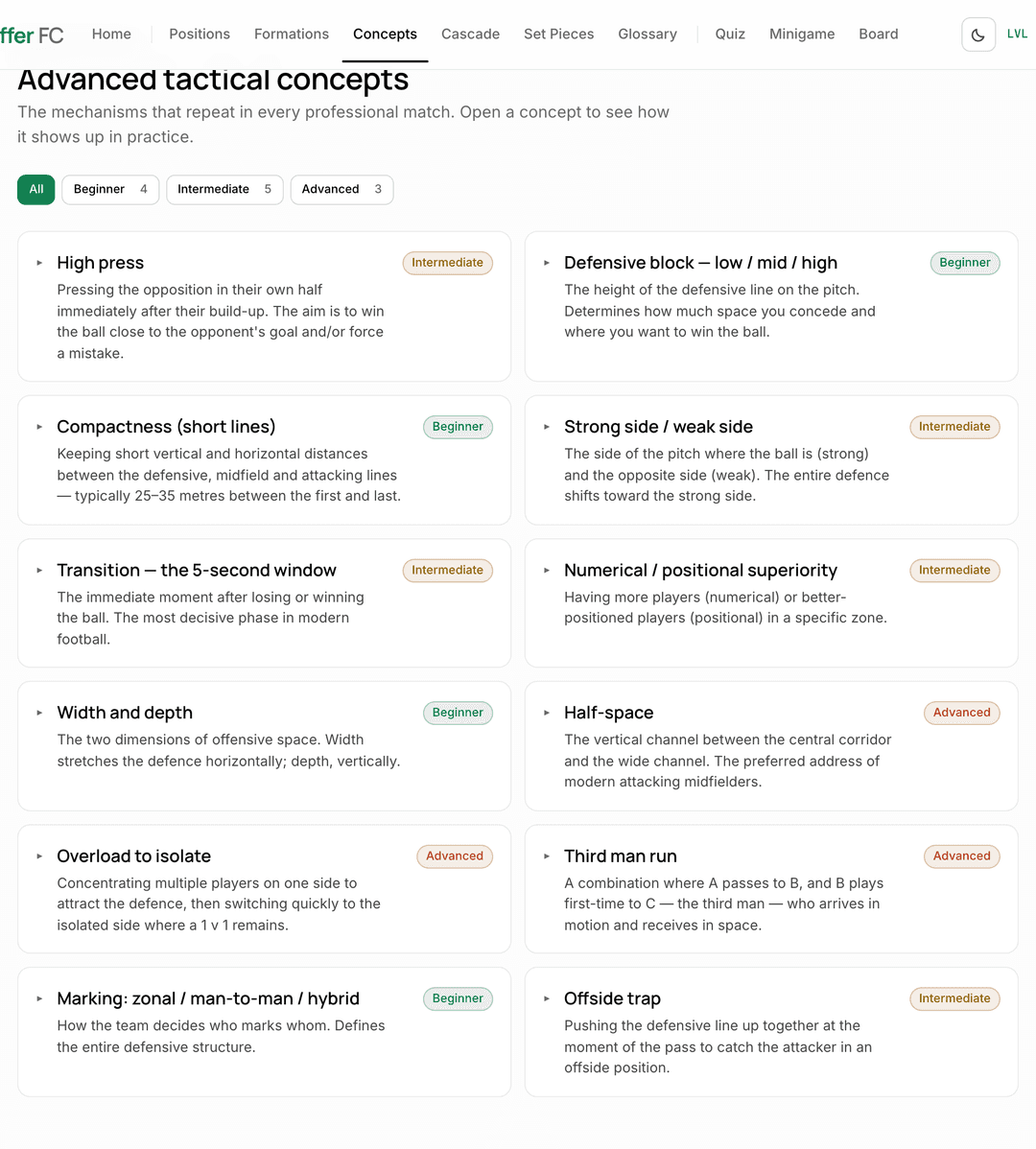
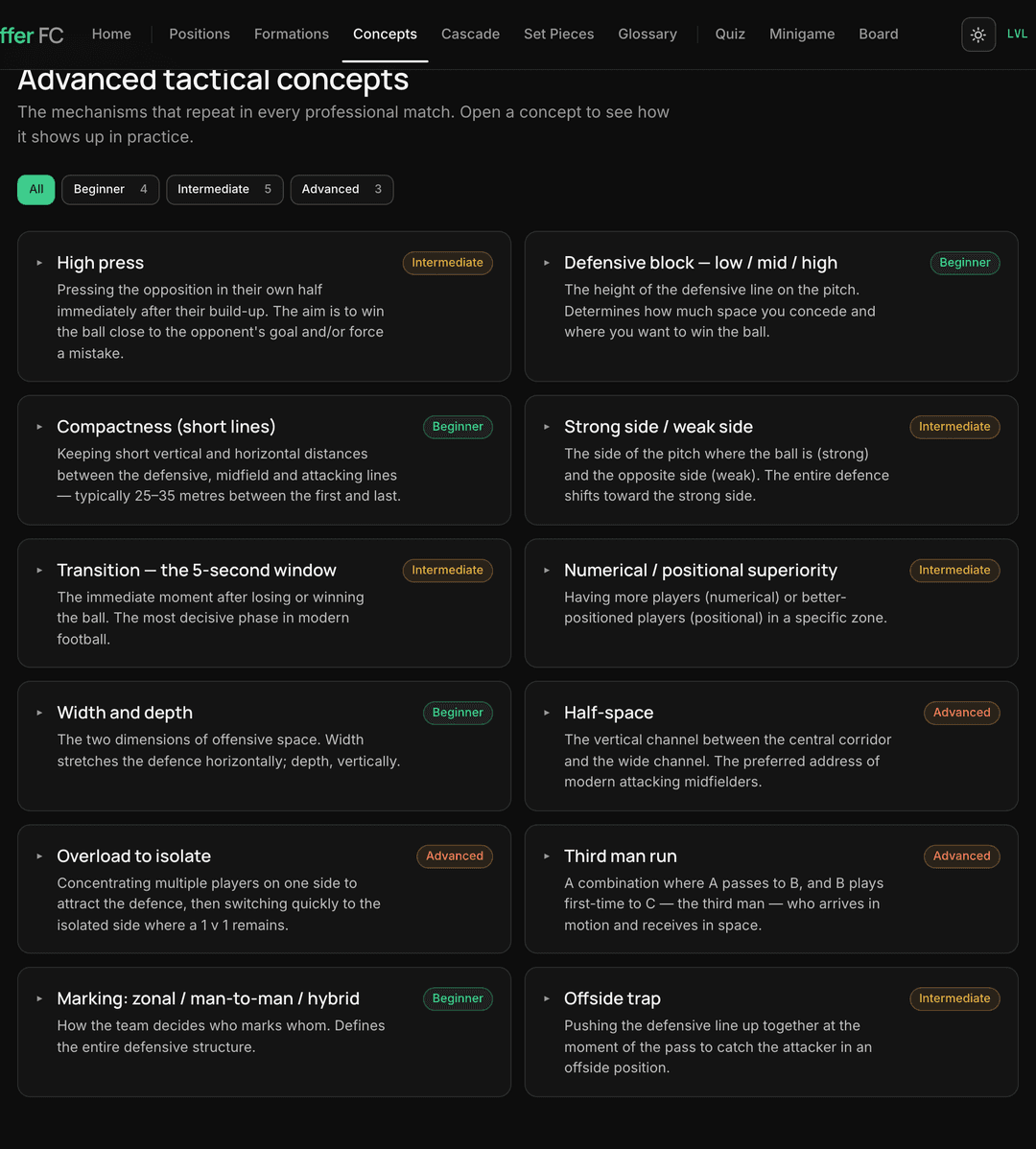
Gaffer FC follows a suggested trail: Positions, Formations, Concepts, Cascade, Set Pieces, Quiz, then Minigame. The 12 concepts are tagged beginner, intermediate or advanced. That sequence is the main thing you pay for. If you prefer to plan your own learning, our free beginner's guide to tactics sets out a sensible order you could follow on YouTube.
Where Do You Actually Practise?
This is the clearest difference. YouTube has no practice built in; Gaffer FC is mostly practice.
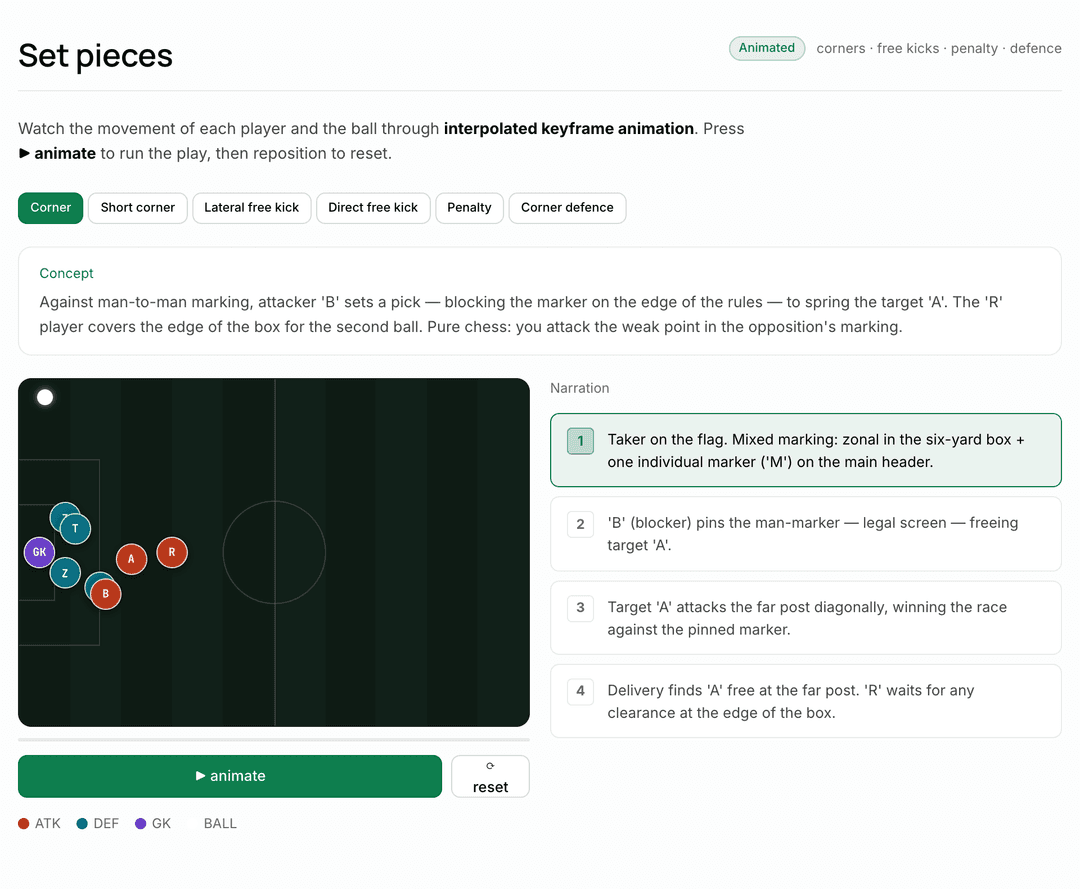
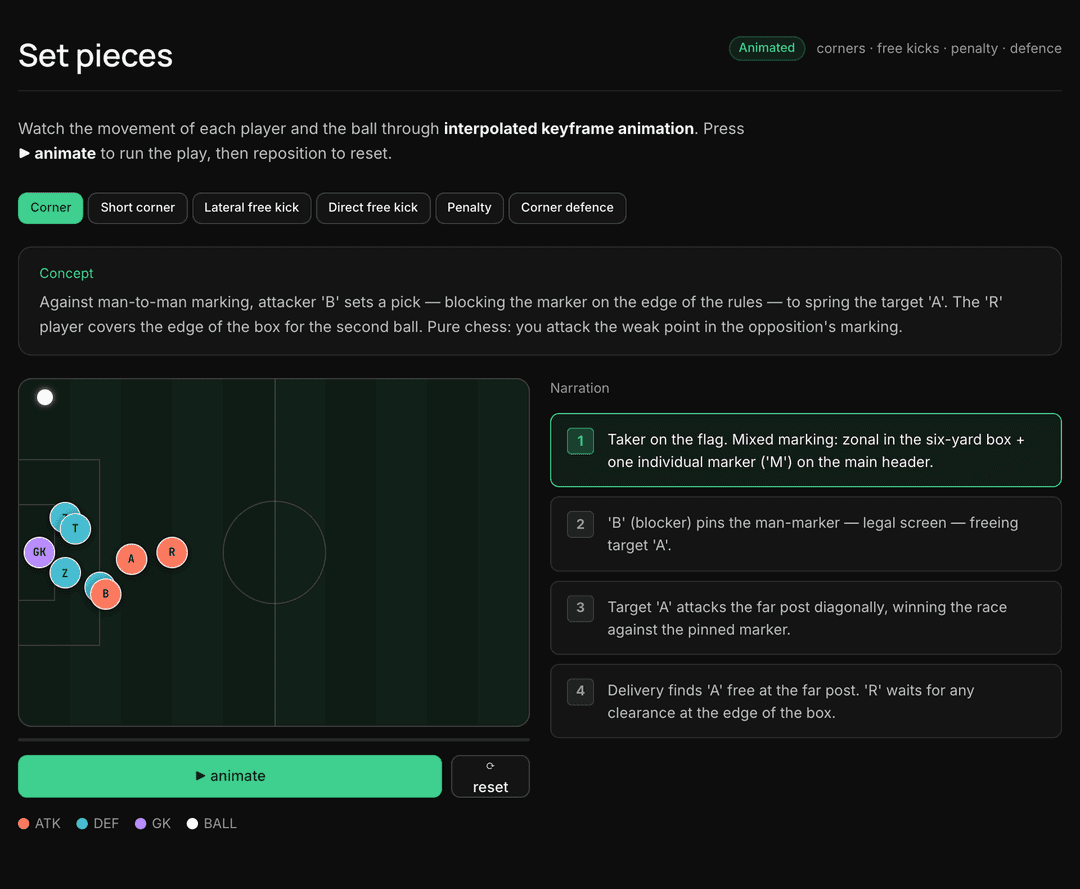
In Gaffer FC you click players to explore roles, step through cascades where one movement triggers a chain reaction across both teams, answer 18 quiz questions with instant feedback, and play a turn-based minigame where every decision is rated Excellent, Neutral or Poor. In one minigame phase, for example, the CPU builds out from the back and you must choose between a high press with a triggered run, a mid-block, a low block or a man-to-man press. We break that down in how the minigame works.
The trade-off is realism. A minigame phase is a simplified situation with a short list of options. A YouTube breakdown shows the messy, real version, with 22 players and imperfect execution. Practice without real examples can feel abstract; real examples without practice tend to fade.
How Do the Costs Compare?
YouTube is free to watch, with adverts. Gaffer FC is a one-time payment of US$37, with lifetime access, no subscription and future content updates included. There is a 7-day money-back guarantee, explained on the refund page.
The real cost of YouTube is time spent choosing, and the risk of watching a lot while retaining little. The real cost of Gaffer FC is the money, plus the limits: no video, no community, and progress saved only in the browser on one device. Neither is free of trade-offs.
One more practical difference: a YouTube video does not know what you have already learned. Every explainer has to start from scratch, or assume you know things you may not. A course with a fixed sequence can build each step on the last, so the concepts page assumes you have seen the positions, and the minigame assumes you have seen the concepts. That is worth more to a beginner than to someone who already knows the basics.
When Is YouTube Alone Enough?
YouTube alone is enough for many fans, and we would rather say so. It is probably all you need if any of these apply:
- You already know the basics, such as formations, pressing and the main roles, and want analysis of specific teams.
- You enjoy tactics as entertainment and are not bothered about retaining the details.
- You learn well from video and already pause, rewind and test yourself as you watch.
- You mainly want to keep up with current talking points.
Gaffer FC adds most value if you are near the start, have watched explainers without much sticking, and want a set path with practice. If you are unsure, try a week of the free route first: our tactics reference, the glossary and a few channel videos.
Watch forPick one Tifo or Coaches' Voice video about a team you will watch this week. Before you press play, write down what you expect the team to do without the ball. After the match, check your prediction against what you saw.
How Can You Use Both Together?
The two work best as a loop: learn and practise an idea in Gaffer FC, see it in a YouTube breakdown, then spot it yourself in a live match.
For example, work through the high press concept and the pressing build-up cascade, then play a few minigame matches until your build-out decisions are consistently rated Excellent. Next, find a channel video about a pressing team, such as one of the breakdowns of Jürgen Klopp's teams. Finally, watch a match and use our guide to watching football tactically to look for the press yourself.
That loop covers what each one lacks. YouTube gives you the real thing, Gaffer FC gives you the practice. When you are ready, the pricing section has the details.
Frequently Asked Questions
Is YouTube enough to learn football tactics?
For many fans, yes, especially if you already know the basics and want analysis of particular teams. YouTube's limits are structure and practice: the order depends on recommendations, and watching is mostly passive. If you pause videos, predict what happens next and then test your reads on real matches, you can learn a lot without paying for anything.
Does Gaffer FC have video lessons like YouTube?
No. Gaffer FC has no video lessons or match footage. It teaches through an interactive pitch, animated cascades and set-piece routines with narration, a quiz with instant feedback, a decision-based minigame and a tactics Board. If video is the main way you like to learn, YouTube channels are the better fit, and Gaffer FC works best as a complement.
Which YouTube channels are good for football tactics?
Two well-known options are Tifo Football by The Athletic, which makes illustrated explainers and discusses current stories, and Coaches' Voice, whose Masterclass videos have coaches break down matches they managed. Both were still uploading as of October 2026. Look for channels that use real footage, explain why a team does something, and connect it to a principle.
Should I use Gaffer FC or YouTube first?
If you are a beginner, starting with a structured path helps, because you learn roles and formations before more advanced ideas. If you already know the basics, start with YouTube for the teams you follow and add practice if the details are not sticking. Either way, test what you learn on a real match.