Most fans can learn to recognise formations and basic defensive shapes within a few weeks of focused watching, reading pressing and build-up patterns usually takes a few months, and anticipating what will happen before it happens is an ongoing skill that keeps improving over seasons. There is no fixed timetable, because it depends on how you practise far more than how many matches you watch. Active practice, such as predicting, testing yourself and spacing your learning, speeds every stage up.
Key Takeaways
- Understanding tactics develops in three stages: recognising shapes, reading patterns like pressing and build-up, and anticipating play.
- The first stage is quick for most fans; the later stages depend on deliberate, active watching rather than total hours.
- Learning research rates practice testing and distributed (spaced) practice as high-utility techniques, while rereading and highlighting are rated low.
- Studies of sport expertise show experts pick up perceptual cues better than non-experts, and perceptual training can improve anticipation.
- A realistic plan is one focused match, one short study session and one active-practice session per week.
How Long Does It Really Take to Understand Football Tactics?
It takes weeks to learn the basics, months to read the game comfortably, and seasons to anticipate it well. Those are honest ranges, not promises: we know of no study that measures how long it takes a typical fan, so anyone who gives you a precise number is guessing.
What we can say is that the stages are distinct, and each one depends on the last. You cannot read a pressing trap if you cannot yet see the shape the team is pressing from. Knowing which stage you are at tells you what to practise next.
If you want the broader question of what football IQ is and why it is learnable, read how to improve your football IQ. If you are comparing methods (YouTube, books, coaching badges), see the best way to learn football tactics. This guide focuses on time and stages.
What Are the Stages of Learning Football Tactics?
Stage 1: Recognising shapes (a few weeks)
At this stage you learn to identify formations, positions and the basic defensive heights: high press, mid block, low block. You can look at a goal kick and say "they are in a 4-4-2 without the ball." Most of the work is learning vocabulary and practising counting lines. Our formations hub and positions guide cover the essentials.
Signs you have this stage: you can name both teams' formations within ten minutes of kick-off, and you notice when one changes.
Stage 2: Reading patterns (a few months)
Now you start seeing how shapes move. You notice a team pressing on a backwards pass, a full-back stepping inside, a midfielder dropping to create a back three in build-up. You understand why a team switched from a 4-3-3 to a back five at 1-0 up.
This stage takes longer because it requires connecting ideas, not just naming them. Concepts like pressing triggers, overloads and transitions become things you see, rather than things you have read about.
Signs you have this stage: you can explain why a goal happened tactically, not just who scored.
Stage 3: Anticipating (ongoing)
The final stage is seeing what is about to happen. You spot the overload building on one side before the switch of play, or the gap opening behind a full-back before the pass is played. This is what coaches and analysts do, and it never really finishes; even professionals keep refining it.
Signs you are developing this stage: your predictions during matches are right more often than they are wrong.
Watching a thousand matches passively teaches you less than watching fifty while asking a question each time.
What Does the Research Say About Learning Faster?
Learning science gives two clear lessons, and sport science adds a third.
Testing yourself beats re-reading
In a classic experiment, Roediger and Karpicke (2006) found that students who practised recalling a passage remembered more of it two days and one week later than students who restudied it, even though restudying felt more effective at the time. For tactics, that means predicting what a team will do and checking, rather than re-reading explainers.
Spacing beats cramming
A large review by Dunlosky and colleagues in 2013 rated ten common study techniques. As Kent State University's summary reports, practice testing and distributed practice were the two rated high utility, while rereading and highlighting were among those rated low. Three short sessions across a week will stick better than one long session on a Sunday.
Experts see different things, and that can be trained
A meta-analysis by Mann, Williams, Ward and Janelle (2007), covering 42 studies, found that expert athletes are better than non-experts at picking up perceptual cues, and use fewer, longer visual fixations. A 2024 meta-analysis in Behavioral Sciences, pooling 22 studies, found that perceptual-cognitive training improved team-sport athletes' anticipation and decision-making, though the gain in real games was smaller than in lab tests. These studies are on players, not fans, so treat them as encouraging rather than conclusive for viewers. The direction is clear, though: what you look at, and how often you practise looking, matters.
By the numbersIn Roediger and Karpicke's 2006 study, published in Psychological Science, repeated testing beat repeated studying on retention tests two days and one week later, while restudying only won on a test given five minutes after learning.
What Is a Realistic Weekly Plan?
A realistic plan for a fan with a job and a life is three short blocks a week, about two to three hours in total, most of which you would spend watching football anyway.
- One focused match (90 minutes). Pick a single question before kick-off: "How does the away team build up from goal kicks?" Watch for that only. Write two or three notes at half-time. Our guide on how to watch football tactically has more questions to choose from.
- One short study session (20 to 30 minutes). Learn one new concept, from a guide or the free tactics reference. Keep it to one idea, such as rest defence or the half-space.
- One active-practice session (20 to 30 minutes). Test yourself rather than reading more: a quiz, a scenario where you choose a response, or recreating a goal on a tactics board and explaining each step out loud.
Then repeat. Re-visit a concept from two or three weeks ago every so often, because spacing is what makes it stick. After a couple of months of this, most fans notice they are seeing the second stage, patterns, without trying.
Where Does Gaffer FC Fit In?
Gaffer FC is built for the active-practice part of that plan. It is a browser-based course that follows a suggested trail: Positions, Formations, Concepts (12 tactical concepts at beginner, intermediate and advanced levels), Cascade, Set Pieces, Quiz and Minigame.
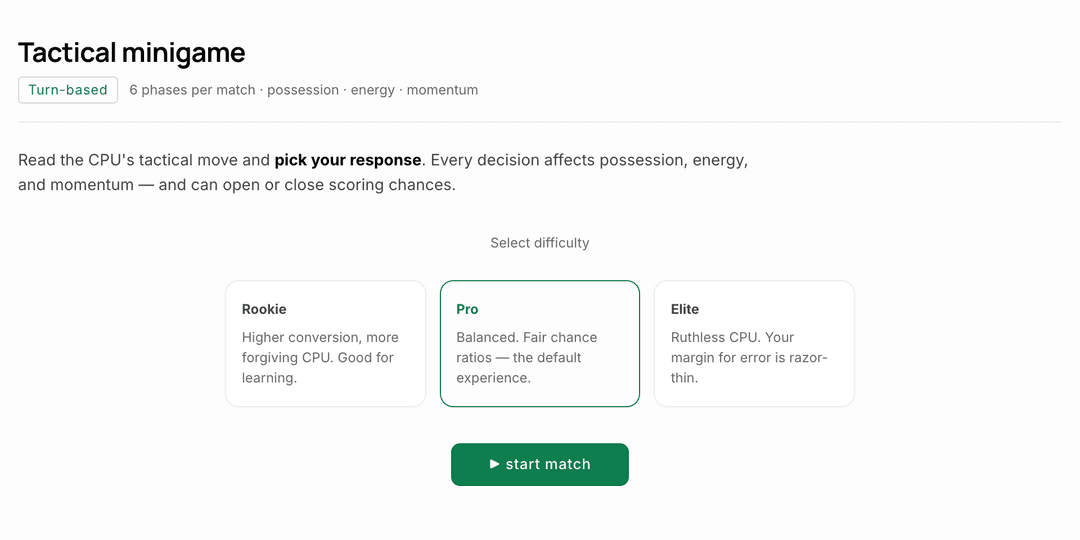
The Cascade module shows a trigger, such as a full-back overlap or losing the ball, and steps through the chain reaction across both teams on an animated pitch. The Quiz has 18 questions with instant feedback. The Minigame is closest to the "predict and check" idea: in each of six phases you read the CPU's move and choose a response, and every decision is rated Excellent, Neutral or Poor.
It will not watch matches for you, and it does not make learning faster by any number we can promise. What it does is give you structured retrieval practice between matches. It costs US$37 once, with lifetime access, and progress is saved in the browser on the device you use. It is not for aspiring coaches who need a licence. You can see the modules at the course overview.
Frequently Asked Questions
Can you learn football tactics without playing football?
Yes. Understanding tactics is mostly about seeing patterns, shapes and decisions, and that is a watching and thinking skill. Playing helps you feel the pressure of decisions, but many respected analysts never played professionally. What matters is active practice: watching with a question, testing yourself and connecting concepts to real matches. Fans who do that consistently improve, whatever their playing background.
How many matches do I need to watch to understand tactics?
There is no magic number, because how you watch matters more than how much. A fan who watches one match a week with a specific question will usually learn more than someone who watches five passively. Aim for one focused match a week, plus short study and practice sessions, and you should notice progress in recognising shapes within a few weeks.
What is the fastest way to understand football tactics?
Combine three things: learn one concept at a time, watch for that concept in a live match, and test yourself on it a few days later. This uses retrieval practice and spacing, the two techniques with the strongest research support. Avoid binge-reading explainers without watching or testing, because rereading feels productive but is one of the least effective ways to learn.
Is it ever too late to learn football tactics?
No. Tactical understanding is a knowledge and perception skill, not a physical one, so you can start at any age. Adults often learn the vocabulary quickly because they have already watched many matches without names for what they saw. The hard part is changing how you watch, and that responds to practice whether you are 15 or 65.